
Why the EU’s new anti-greenwashing rules are good news for shoppers and producers “Greenwashing” just…
Weathering The Moor
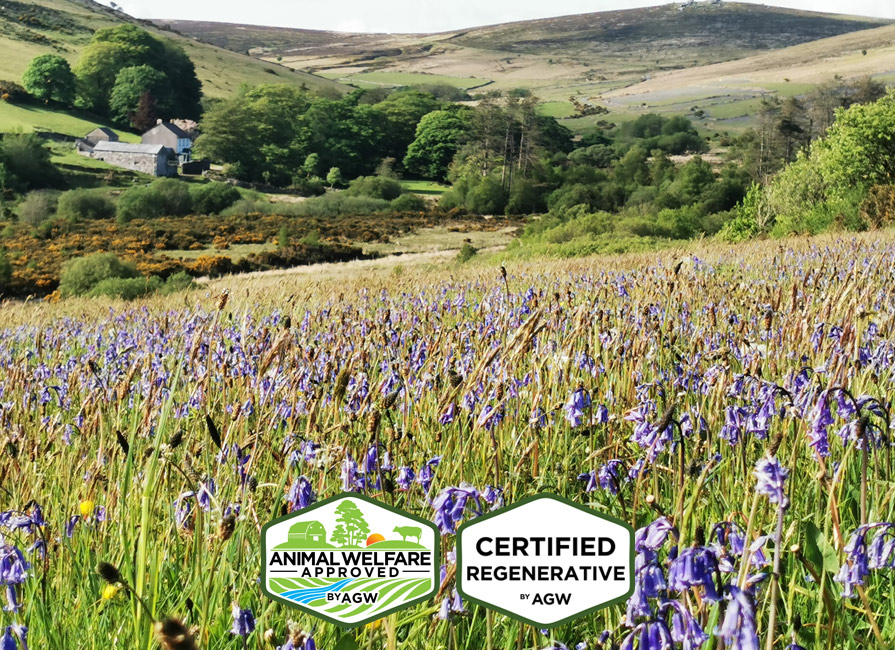
Challacombe Farm sits in a sheltered valley in the heart of the UK’s Dartmoor National Park in Devon. People have farmed this land for at least 3,500 years: Bronze Age shepherds built the Grimspound settlement in the top corner of the farm, medieval farmers cut terraces into the valley sides, and miners dug for tin into the 20th century. Since 1917, the farm has been part of the Duchy of Cornwall estate. My husband Mark and I farm it as tenants, though for me it is simply home. I have lived at Challacombe since I was six years old, and my mother farmed it before us.
Today we manage around 445 acres (180 hectares) of enclosed pasture, rhos pasture (a local type of species-rich, marshy wet grassland characterized by purple moor-grass over deep peat), flower-rich hay meadows, and open moorland. We graze hardy native livestock, including Welsh Black and North Devon beef cattle, a flock of Icelandic and Shetland sheep raised for meat and their beautiful colored fleeces, and a handful of conservation-grazing ponies.
We were the first upland farm in the UK to be Certified Animal Welfare Approved by AGW and, in 2022, after 18 months in the pilot cohort, Challacombe became the first farm in the world to be Certified Regenerative by AGW. We are also certified organic, and everything we produce is sold directly to people who care where their food comes from. The farm also earns its keep in many small ways, from sheepskins, honey and wildflower seed to educational visits and camping.
Our goal has never changed: to raise our cattle and sheep outdoors on pasture, while conserving and enhancing the wildlife, landscape and archaeology that make this such a special place.
Facing the challenges
I have 50 years of experience living in what has always been a humid, mild environment, but it is rapidly changing to warmer and wetter in winter and very dry in summer. All the softness has gone, and we are left with the extremes.
Late last winter it rained every day for eight weeks, with no snow. A total of 1.8 meters (nearly six feet) of rain fell in three months. The ground was sodden, our primitive sheep breeds were miserable and losing body condition, and most days we got through three sets of waterproofs (rain gear), which was sapping. As we write at the end of July, we are in the middle of the third heat wave to hit the UK this year alone. It has burned off all our grass, and only the wetlands are flourishing.
Disease is what has caught us most off guard. Tick-borne diseases used to be sporadic here. Now they come every spring and autumn with the cyclical “tick rise.” Midge-borne diseases such as bluetongue are arriving, too, and we are working out the best, highest-welfare strategy with our vet.
Why we farm regeneratively
At Challacombe, nature always comes first, and our animals are the tools we use to manage it. Our guiding principle is simple: what will deliver the best outcome for nature, in this place, at this time? We have tried fighting nature, and it never works or pays in the long term. Working with nature means considering the right animal, in the right place, at the right time, to deliver what nature needs. Letting nature drive our business decisions felt a little odd at first; now it is central to everything we do.
It makes financial sense, too. As tenant farmers, the only costs we can really control are our variable costs, so we squeeze those hard, making sure the most suitable livestock use every bit of production from our grass. Cattle, sheep, and ponies make a great mix, each with their own preferences and grazing patterns, and the mosaic created by mixed grazing, the action of hooves, and no ivermectins is very good for the insects at the base of the food chain. That abundance draws visitors, who have free access to see wild nature, and they become willing customers for our meat and sheepskins.
That whole-farm way of thinking is why Certified Regenerative by AGW made sense, giving us external, independent verification at a time when many people claim they are “regenerative.” Our regenerative plan has not changed since 2022, but the way we view it has. It is a flexible tool that supports innovation, not a rigid framework we must adhere to. Our milestones may shift to reflect the changing climate, but the goal is fixed: healthy, high-welfare livestock, kept in a truly sustainable way.
Adaptations on the farm
- Fewer, better, hardier animals
We have reduced our cattle numbers so that we produce fewer, but higher quality, store cattle from the grass the farm can actually grow. We are purely grassfed from the farm, with no imported feed, which keeps our variable costs down, and we have doubled down on hardy native breeds that thrive in a harsh place. Fewer mouths means the farm copes better in a droughted summer or a sodden winter, and the animals stay in better condition.
- Grazing with the medieval fields
Most of our farm is protected by law for its medieval landscape of ancient field strips, which means we are not allowed to mob graze with electric fencing. So, we have adapted, grazing large paddocks of around 75 acres (30 hectares) that mirror the big medieval fields known as “wares.” Fifty cattle graze with 250 sheep and six ponies for a week, or until a third of the forage is eaten, before they move on, giving each paddock a rest of at least 10 weeks. The long rests keep parasite burdens down, and we have plenty of forage through the year.
- Holding water on the farm
Much of our climate work comes down to one idea: slow the water down and keep it here. We have blocked old drainage ditches to retain soil moisture and created lots of multi-functional ponds and scrapes across the farm for wildlife and for livestock drinking and cooling. We profile the edges so there are no drops, leave deeper cold-water spots to reduce algae, and run the outflows into grassland or scrub so nothing pollutes or silts up downstream. These wetlands receive and hold water in wet times and release it gently, cooling the ground, building peat that locks up carbon, and protecting communities lower down the catchment. They bring some parasite issues, such as liver fluke, but they allow us to always have forage available.
- Trees from our own seed
We have sufficient tree cover for shelter and shade, but we need more so that every paddock has decent shade. Tall hedges help, but they do not work all day as the sun moves. Young trees are costly to buy, and organic-certified stock is difficult to source at scale, so we gather seed from selected mature trees in our tall hedgerows and grow them on in our garden. These locally adapted trees and shrubs have a high success rate and give us a real sense of pleasure. After experimenting with tree guards, we settled on reusable “cactus” guards of spiky galvanized mesh, which repel even the most curious cows.
- Meadows and spring ewes
Our flower-rich hay meadows give us winter feed for the cattle and a seed source. We harvest and sell wildflower seed and green hay to neighboring farms, once again spreading locally adapted genetics across the moor. In spring, the heavily pregnant ewes graze the meadows, a traditional practice in our area that knocks back the dominant grasses and lets the less aggressive flowers flourish.
What we are learning
The biggest lesson is how quickly nature responds when you give it the chance. The hardest lessons are more personal. We can trace all our cattle back to the founding mothers of our herd, and we can see that some bloodlines do not tolerate change as well as others. They are more prone to heat stress and are simply not thriving, so we no longer keep heifer replacements from those lines. It is the right business decision, but it is also poignant. These were my parents’ bloodlines, and it feels like the end of an era.
Disease is the other hard teacher. With tickborne fevers on the rise, livestock need to be raised on the farm from a young age to build immunity, so we run a closed herd and buy in only bulls. But a good bull is expensive, and he needs treating with Imizol to prevent redwater fever (bovine babesiosis), a miserable disease with a high fatality rate. The treatment is costly, too, and its 213-day withdrawal period doubles for organic farms. Diseases are moving up from the south, and that risk will only grow. It demands constant vigilance and a sharp eye for new behaviors or symptoms, but regular catch-ups with our vet make the change feel more manageable.
Looking forward
Away from the areas protected for archaeology, we would ultimately like to reach “thirds.” One third open grassland, one third scrubby bushes, and one third closed-canopy cover of native trees, all interspersed with grazing and providing browse, shelter, and shade. My biggest concern is that it will look messy, because it will be a dynamic, changing landscape, and as a tenant I will need to discuss the concept with our landlord. I think they will be open to it if I can articulate the benefits clearly. For us, it comes down to legacy and what we pass on.
If I could offer one practical takeaway, it is this. Do not wait for a drought to think about water. Slow it down, store it, and let your land hold it for you and others downstream. And remember that diversity is key: spread your risks, watch your stock, see what thrives, and be open to changing your system—and your mind—if things do not work. This moor has been farmed through 3,500 years of change. Our job is to make sure it can continue.
Author: Naomi Oakley farms Challacombe Farm in Dartmoor National Park, England, with her husband Mark Owen. Visit https://www.dartmoorfarm.com/
Originally published in the Fall 2026 issue of AGW’s Sustainable Farming magazine.
Related Posts


